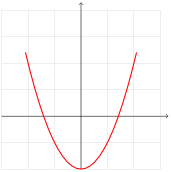
The 13 axioms A1-A4, M1-M4, D, O1-O4 define an ordered field, with the rational numbers \(\mathbb Q\) as the most basic example. But we have mentioned in Subsection 1.1.3 (and proved in Example 1.5.3) that a basic problem such as finding the side of a square with area equal \(2\) cannot be solved in \(\mathbb Q\text{.}\) Another way to see that the rational numbers are “incomplete” is to look at the graph of the parabola \(y=x^2-2\text{,}\) pictured below. If we work with only rational numbers, we need to conclude that this graph has no \(x\)-intercepts.
Figure2.2.1.Graph of \(y=x^2-2\)
In this section, we will add one more axiom. The resulting ordered field is the field of Real Numbers.
In order to formulate the Completeness Axiom, we first make some definitions.
Subsection2.2.1Maximum and minimum
Definition2.2.2.
Let \(F\) be an ordered field, and \(S\subset F\text{.}\)
We say that an element \(M\in S\) is the maximum of \(S\) if \(x\leq M\) for all \(x\in S\text{.}\)
We say that an element \(m\in S\) is the minimum of \(S\) if \(x\geq m\) for all \(x\in S\text{.}\)
Intuitively, this definition is just telling us that the maximum of \(S\) is the “largest” element of \(S\) and the minimum is the “smallest”. But we never discussed what “large” or “small” mean! We always need to formulate our definitions using only the field axioms, and that is what the above definition does.
There are two important observations to make at this point.
The maximum, or the minimum, of a subset does not have to exist. For example, if \(S=[0,2)=\{x\in {\mathbb Q}|0\leq x \lt 2\}\text{,}\) then \(0\) is the minimum of \(S\text{,}\) but there is no maximum. If \(S=(2,\infty)=\{x\in {\mathbb Q}|x\lt 2\}\text{,}\) then \(S\) has neither maximum nor minimum. Note how the two sets \([0,2)\) and \([0,\infty)\) fail to have a maximum for two very different reasons.
If a subset \(S\) has a maximum, then it is unique. Similarly, if \(S\) has a minimum, it is unique (see the exercises). This explains why the definition says the maximum, and not a maximum.
Subsection2.2.2Upper and lower bounds
In the definition of maximum and minimum, we required that the elements \(M\) and \(m\) be members of the subset \(S\text{.}\) If we do not, we obtain the notion of upper and lower bounds, described next.
Definition2.2.3.
Let \(F\) be an ordered field, and \(S\subset F\text{.}\)
We say that an element \(U\in F\) is an upper bound for \(S\) if \(x\leq U\) for all \(x\in S\text{.}\)
We say that an element \(u\in F\) is a lower bound for \(S\) if \(x\geq u\) for all \(x\in S\text{.}\)
So for example if \(S=[0,2)\text{,}\) then \(2\) is an upper bound for \(S\text{,}\) but it is not the maximum, because it is not a member of \(S\text{.}\) Note that, unlike for maximum and minimum, the definition says an upper bound, and not the upper bound, and that is easy to understand: in the same example \(S=[0,2)\text{,}\)\(3,4,5\) or any number larger than \(2\) is also an upper bound. So if there is an upper bound \(M\text{,}\) any larger element \(M'\gt M\) will also be an upper bound. And similarly, if there is a lower bound \(m\text{,}\) and smaller element \(m'\lt m\) will also be a lower bound.
Just like the maximum and minimum, upper and lower bounds do not always exist: just consider any subset that extends forever to the right, such as \([0,\infty)=\{x\in {\mathbb Q}| x\geq 0\}\text{.}\) There is no upper bound for this subset. Similarly, there is no lower bound for \((-\infty,0]\text{.}\)
Subsection2.2.3Bounded sets
As we just noticed, there are sets that do not have upper or lower bounds. In this section we focus on those sets that do.
Definition2.2.4.
Let \(F\) be an ordered field, and \(S\subset F\text{.}\)
We say that \(S\) is bounded above if \(S\) has an upper bound. So this means that there is some \(M\in F\) such that \(x\leq M\) for all \(x\in S\text{.}\)
We say that \(S\) is bounded below if it has a lower bound. So this means that there is some \(m\in F\) such that \(x\geq m\) for all \(x\in S\text{.}\)
If \(S\) is both bounded above and below, then we say it is bounded.
If \(S\) is not bounded above, or is not bounded below, then we say that it is unbounded
Example2.2.5.
In \(\mathbb Q\text{,}\)\(S=(-\infty,2)=\{x\in {\mathbb Q}|x\lt 2\}\) is bounded above, because \(2\) is an upper bound for it. In fact, any number greater than \(2\) will also be an upper bound. But \(S\) is not bounded below. So it is unbounded. And this subset has neither a minimum, nor a maximum.
\(S=[0,2)=\{x\in {\mathbb Q}| 0\leq x \lt 2\}\) is bounded both above and below. An upper bound is any number greater than or equal to \(2\text{,}\) and a lower bound is any number less than or equal to \(0\text{.}\) So \(S\) is bounded. It has no maximum, and \(0\) is the minimum.
Subsection2.2.4Supremum and infimum
Suppose \(S\) is a subset of an ordered field. We can then consider the set \({\cal U}(S)\) of all the upper bounds for \(S\text{,}\) and the set \({\cal L}(S)\) of all the lower bounds for \(S\text{.}\) Then, by definition, \({\cal U}(S)\) is not empty exactly when \(S\) is bounded above, and \({\cal L}(S)\) is not empty exactly when \(S\) is bounded below.
Example2.2.6.
In the ordered field \(\mathbb Q\text{,}\) if \(S=[0,2)\text{,}\) then \({\cal U}(S) = [2,\infty)\text{,}\) and \({\cal L}(S)=(-\infty,0]\text{.}\)
If \(S=(0,\infty)\text{,}\) then \({\cal U}(S)=\emptyset\text{,}\) and \({\cal L}(S) =(-\infty,0]\text{.}\)
We are now ready for a central definition in Real Analysis.
Definition2.2.7.
Let \(F\) be an ordered field, and \(S\subset F\text{.}\) If the minimum of the set \({\cal U}(S)\) exists, we call it the supremum or the least upper bound of \(S\text{,}\) and denote it by \(\sup S\text{.}\) If the maximum of the set \({\cal L}(S)\) exists, we call it the infimum or the greatest lower bound of \(S\text{,}\) and denote it by \(\inf S\text{.}\)
So (if it exists) \(\sup S\) is the smallest of all the upper bounds of \(S\text{,}\) and that explains well the name “least upper bound”, and similarly, if \(\inf S\) exists, it is the largest of all the lower bounds of \(S\text{.}\)
Remark2.2.8.
An obvious but often very useful observation is that if we decrease \(\sup S\) by any positive amount \(\epsilon\) (no matter how small), it can no longer be an upper bound for \(S\) (because it would contradict the fact that \(\sup S\) is the least upper bound). This means that there must be some element \(s\) of \(S\) such that \(s \gt \sup S -\epsilon\text{.}\) This simple observation is often the key to proving results involving the supremum. Of course a similar observation refers to the infimum: \(\inf S +\epsilon\) cannot be a lower bound, and so there must be some \(s\in S\) such that \(s\lt \inf S +\epsilon\text{.}\)
We said that \(\sup S\) is the least upper bound for \(S\text{,}\) if it exists. The “if” in this sentence is at heart of Real Analysis. Because there are subsets of \(\mathbb Q\) that are bounded above, so that \({\cal U}(S)\) is not empty, and yet \({\cal U}(S)\) has no minimum! (or, in our new notation, \(\sup S\) does not exist). This is what leads us to consider a larger set of numbers, obtained by adding one more axiom. Before doing that, we will produce a basic example of a set in \(\mathbb Q\) that is bounded above but it has no supremum.
Example2.2.9.
Let \(S=\{x\in {\mathbb Q}|x^2\lt 2\}\text{.}\) Then \(2\) is an upper bound for \(S\) (see the exercises). So \({\cal U}(S)\) is not empty. We will now show that \(S\) has no supremum. We proceed by contradiction. So suppose that \(p=\sup S \in {\mathbb Q}\text{.}\) We will use the rational number
We know from Example 1.5.3 that \(p^2\neq 2\text{.}\) So either \(p^2\lt 2\text{,}\) or \(p^2\gt 2\text{.}\)
If \(p^2\lt 2\) then (2.2.2) shows that \(q^2\lt2\text{,}\) and so \(q\in S\text{,}\) and (2.2.1) shows that \(q\gt p\text{.}\) But this contradicts the fact that \(p\) is an upper bound for \(S\text{.}\)
If \(p^2\gt 2\text{,}\) then (2.2.2) shows that \(q^2\gt 2\text{,}\) and this means that \(q\) is an upper bound for \(S\) (see the exercises). But then (2.2.1) shows that \(q\lt p\text{,}\) and this contradicts the fact that \(p\) is the least upper bound for \(S\text{.}\) So in either case we reach a contradiction, and we conclude that \(\sup S\) does not exist.
Subsection2.2.5The completeness axiom
We had already learned from Example 1.5.3 that the rational numbers have some “holes”, because there is no rational number \(x\) such that \(x^2=2\text{.}\) The last example in the previous section tells us how to fill the holes: if we add one more axiom to make sure that the set \(\{x\in {\mathbb Q}| x^2\lt 2\}\) has a supremum, then that supremum will be the solution of \(x^2=2\text{,}\) or in other words, it will be \(\sqrt{2}\text{.}\)
Axiom C (Completeness)
Suppose \(S\subset F\text{.}\) If \(S\) is bounded above, then \(\sup S\) exists. If \(S\) is bounded below, then \(\inf S\) exists.
We are now ready to give a formal definition of the main object of study in this course.
Definition2.2.10.
We denote by \(\mathbb R\) the ordered field that contains the rational numbers and satisfies the 14 axioms A1-A4, M1-M4, D, O1-O4, C. The elements of \(\mathbb R\) are called real numbers.
Note that in the definition we wrote “the” ordered field. That is because \(\mathbb R\) is unique, meaning that any other ordered field satisfying the same 14 axioms must in fact be essentially a copy of \(\mathbb R\text{.}\) We will not try to make the above assertion precise. A precise statement of what “essentially a copy” means and a proof can be found in various standard references for Real Analysis. 1
So \(\mathbb R\) is an extension of \(\mathbb Q\) (meaning that it contains \(\mathbb Q\) as a subset) and we have the inclusions
\begin{equation*}
\mathbb N \subset \mathbb Z \subset \mathbb Q \subset \mathbb R.
\end{equation*}
Any fact about real numbers is a consequence of the 14 axioms.
So in \(\mathbb R\) every subset that is bounded above has a supremum, and every subset that is bounded below has an infimum. If \(T=\{x\in {\mathbb R}: x^2\lt 2\}\text{,}\) then \(T\) is bounded above by \(2\) (by using the same proof as the one used in \(\mathbb Q\text{,}\) see the exercises), and by the completeness axiom, \(\alpha=\sup T\) exists, and we can prove that \(\alpha^2 =2\text{,}\) so that \(\alpha\) is the familiar \(\sqrt{2}\text{.}\) It also follows that \(x^2\lt 2\) is equivalent to \(-\sqrt{2}\lt x \lt \sqrt{2}\text{,}\) so \(T=(-\sqrt{2},\sqrt{2})\text{,}\) and \(\sup T=\sqrt{2}\text{,}\)\(\inf T=-\sqrt{2}\text{.}\)
We also define \(\sup S=+\infty\) in case \(S\) is not bounded above, and \(\inf S=-\infty\) in case \(S\) is not bounded below. But bear in mind that \(\infty\) and \(-\infty\) are not real numbers, they are just symbols. We extend the use of \(\lt \) and \(\gt \) by writing that \(x\lt \infty\) and \(x\gt -\infty\) for any real number \(x\text{.}\) We can also write that \(x+\infty =\infty\) and \(x-\infty = -\infty\) for all \(x\in {\mathbb R}\text{.}\) But we must be very careful in doing algebra with the symbols \(\infty\) and \(-\infty\text{.}\) In particular, \(-\infty\) is not the additive inverse of \(\infty\text{.}\)
As a final common convention, we define \(\sup \emptyset = -\infty\) and \(\inf \emptyset = \infty\text{.}\) This is actually more than just a convention: it is an exercise in logic to show that this definition is the right one.
We can now prove that the intervals are precisely the subsets listed in Definition 2.1.10.
Lemma2.2.11.
All the subsets in the list Definition 2.1.10 are intervals, and if \(I\) is an interval, then it is one of those.
Assume \(I\) is an interval, and consider the various cases: \(I\) is bounded above (or below), or is not, and if it is bounded above (or below), its supremum (or its infimum) belongs to \(I\text{,}\) or it does not.
Definition2.2.12.
A subset \(S\) of \(\mathbb R\) is said to be open if it satisfies the following property: for each \(c\in S\text{,}\) we can find some \(\epsilon \gt 0\) such that \((c-\epsilon,c+\epsilon)\subset S\text{.}\)
Lemma2.2.13.
Let \(a,b\in {\mathbb R}\text{,}\) with \(a\lt b\text{.}\) Then \((-\infty,a),(a,\infty), (a,b), (-\infty,\infty)\) are all open intervals, and any open interval is one of this form.
Proceed by contradiction and suppose that \(M=\sup {\mathbb N}\) exists. Then consider \(M-1\text{,}\) and use Remark 2.2.8.
Proof Suppose that \(M=\sup {\mathbb N}\text{.}\) Then \(M-1\) cannot be an upper bound for \({\mathbb N}\text{,}\) because \(M\) is the least upper bound. This means that there must be some positive integer \(n\) such that \(n\gt M-1\text{.}\) But then \(n+1\) is an integer, and \(n+1\gt M\text{,}\) contradicting the fact that \(M\) is an upper bound for \(\mathbb N\text{.}\)
At first sight the Archimedean principle may seem obvious, because we know that there is no largest integer (we can always add \(1\) to any integer and get a larger one). But this theorem is more subtle than that. It says that there is no real number that can be an upper bound for \(\mathbb N\text{.}\) It may come as a surprise that this can only be proved by appealing to the completeness axiom. In fact, there are examples of ordered fields that contain the rational numbers, and where the positive integers are actually bounded above! See this discussion 2 . In such an ordered field, the completeness axiom will not be valid.
Subsection2.2.7Equivalent forms
The Archimedean principle can be formulated in several different ways. Each of these formulations is sometimes useful in the course of proving results in Real Analysis, and the next theorem shows that they are all equivalent.
Theorem2.2.15.
The following statements are equivalent:
The Archimedean principle
If \(x\in \mathbb R\text{,}\) then there is some \(n\in \mathbb N\) such that \(n\gt x\text{.}\)
If \(x\in \mathbb R\text{,}\)\(x\gt 0\text{,}\) and \(y\in \mathbb R\text{,}\) then there is some \(n\in \mathbb R\) such that \(nx\gt y\text{.}\)
If \(x\in \mathbb R\text{,}\)\(x\gt 0\text{,}\) then there is some \(n\in \mathbb N\) such that \(\frac{1}{n}\lt x\text{.}\)
In order to prove that several statements are equivalent, we need to show that any of them implies any of the others. An efficient way of doing this is to proceed in a circular fashion:
Figure2.2.16.Plan of proof
Figure 2.2.16 means that we plan to prove that \(i.\Rightarrow ii.\text{,}\) then that \(ii.\Rightarrow iii.\text{,}\) and so on, until we come full circle. When we proceed this way, the order in which we list the statements can make a big difference in how difficult the proofs of the various steps are. So we could say that listing the various statements in the best order is really part of the proof! For Theorem 2.2.15, the order of the statements has already been arranged to make the proof as simple as possible.
To prove i.\(\Rightarrow \) ii., remember that the Archimedean principle is the negation of the statement “\(\mathbb N\) is bounded above”.
To prove that ii.\(\Rightarrow \) iii., assume ii. true. Given \(x,y\in \mathbb R\) with \(x\gt 0\text{,}\) apply ii. to \(x^{-1}y\text{.}\)
To prove iii.\(\Rightarrow \) iv., assume iii. true. Given \(x\gt 0\text{,}\) use iii. with \(y=1\text{.}\)
To prove iv.\(\Rightarrow \) i., assume iv. true and proceed by contradiction, by assuming that i. is false, so that \(\mathbb N\) is bounded above.
Subsection2.2.8Density of \(\mathbb Q\)
We now discuss two basic theorems that are often needed in Real Analysis. Informally, the first describes how the integers \(\mathbb Z\) “sit inside” \(\mathbb R\text{,}\) because it tells us that every real numbers is in between two consecutive integers. The second describes how \(\mathbb Q\) “sits inside” \(\mathbb R\text{,}\) because it tells us that in any interval of real numbers, no matter how small, we will always find a rational number.
Theorem2.2.17.
Let \(x\in {\mathbb R}\text{.}\) Then there is a unique integer \(m\) such that \(m-1\leq x \lt m\text{.}\)
First assume that \(x\geq 0\text{,}\) and define \(S=\{n\in {\mathbb N}: x\lt n\}\text{.}\) Prove that \(S\) cannot be empty, and use the Well-Ordering Principle. Then, in case \(x\lt 0\text{,}\) define the set \(T=\{n\in {\mathbb N}:
x+n\geq 0\}\) and again show that \(T\) cannot be empty.
Theorem2.2.18.(Density of \(\mathbb Q\)).
Suppose that \(x,y\in {\mathbb R}\) and \(x\lt y\text{.}\) Then there is some \(r\in {\mathbb Q}\) such that \(x\lt r \lt y\text{.}\)
Consider the distance between \(x\) and \(y\text{,}\) that is, \(y-x\gt 0\text{.}\) Apply the Archimedean principle Theorem 2.2.15 version iv. to find a positive integer \(n\) such that \(1/n\lt (y-x)/2\text{.}\) Then consider the set \(S=\{k\in {\mathbb N}: k/n\gt x\}\text{.}\)
See DJH Garling, A Course in Mathematical Analysis Vol 1 (2013), page 91: para 3.3 for a proof that there is only one ordered field that satisfies the completeness axiom, or these notes.